To Be Shot at Dawn
I’m a night person. I like the dark. Or to be more exact, I like the night. It’s quiet and peaceful, especially out in the country. But the dawn is better, because if you want to have the place to yourself, in England at least, this is the only time you’re likely to be able to achieve it.
When I was younger, particularly in that period in the late 1970s between leaving Parkside Mental Hospital and being prescribed the diazepam which would allow me to go out socially, I used to go out late at night a lot. It meant that I would be able to enjoy solitude in areas which would later in the day be crowded with walkers and tourists. Furthermore, after sunrise, which in summer could be very early indeed, I would be able to take photographs of what I saw.
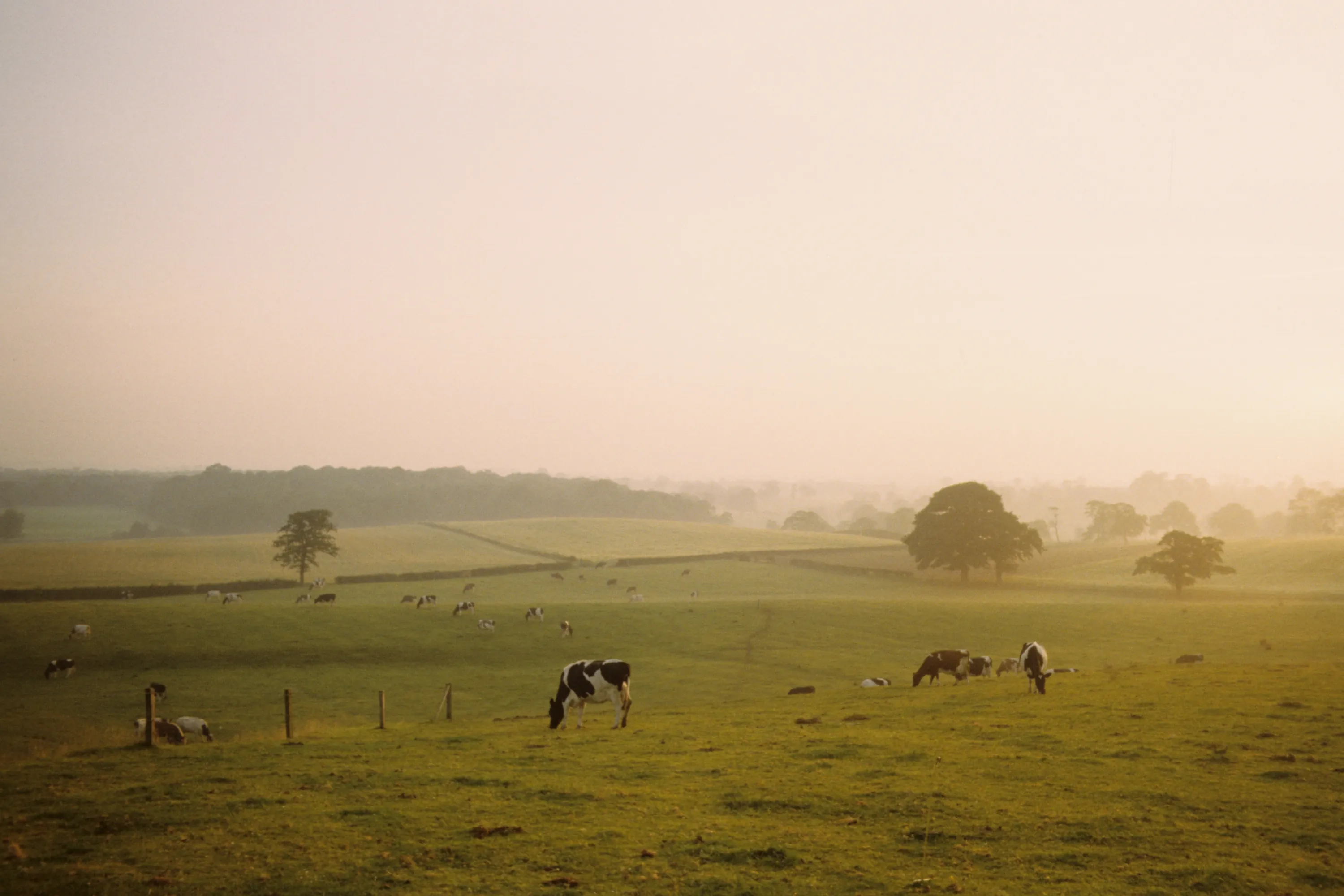 Sunlight at dawn illuminating the mist over the fields; the view from Mutlow, Chesire, June 1979.
Quite apart from the landscapes being unblemished by unnecessary humans, who spoil the view, you didn’t have the awkwardness of the social niceties of what to say if you meet one. However there was one occasion which I will long remember in which… well, let me describe it to you.
I’d gone out one night to a place not far from Congleton, and the dawn had just arrived but the sun not yet risen. Everything was in that dimly-lit state where you think you can see things better than is really the case. I stood at a junction of two small lanes, deciding which way to go. What with both the early hour – it must have been about four or five o’clock – and the isolation of the place, it was utterly quiet, and I felt that pleasant sensation of being quite alone. I paused reflectively, enjoying the solitude. It was nice to have the place to myself. I had been standing there for perhaps five or ten minutes before I moved on down one of the lanes.
I was glad I hadn’t indulged in one of those unpleasant habits one sometimes does when one believes oneself to be alone (picking one’s nose, sniffing one’s armpits), for I had only walked a few dozen paces before I became aware of a Presence. I turned my head and saw, off to the side of the road, beyond a low wire fence and a rough area of bilberry and heather, standing just inside the edge of a copse of silver birches, was a man with an automatic rifle. Or was it a submachine gun? A machine pistol? I am not particularly familiar with the distinctions, and my normal clarity of thought had been somewhat disrupted. He was wearing camouflage clothing and was standing perfectly still; he was not facing me directly but I sensed that he was looking at me – don’t ask me how; one gets these instinctive feelings at times. Besides, when two people are alone together and are aware of each other’s presence they tend to be very conscious of the other’s possible thoughts. He was only about fifteen or twenty metres away. I was nonplussed. Should he be there? Should I be there? Should I attempt to summon the police? Or, given the surreal feel to the encounter, perhaps a psychiatrist?
I should hasten to say that if it had been a shotgun it would have been a different matter. Being threatened by a man with a shotgun in rural areas is to be considered normal. It has happened twice to me; once by a farmer and once by a gamekeeper. On the former occasion I had been walking across a field with sheep and new-born lambs in it; the farmer had appeared and was apparently under the belief I was carrying disease which would threaten his livestock.
‘We’re allowed to shoot dogs and the sooner we’re allowed to bloody well shoot people the better. Now bugger off!’ It was something like that anyway. I had left, since an attempt at continuing the conversation had seemed pointless.
On the latter occasion it was up on the moors, where the only productive thing to be done with the heather-covered land is to rear game-birds. They were protected and nurtured with fierce jealousy in order that they may, at some later date, be shot for amusement by persons with more money than is proper for any individual to have. This time the gamekeeper who confronted me, shotgun broken over his forearm, but no doubt ready to be snapped shut should I prove irritating to him, told me that I should not be there as I may frighten the birds. As anyone knows who has walked across moorland with grouse among the heather, the birds have a habit of lying low until your foot is about to descend upon them; then they will fly up with a tremendous clatter of wings, leaving you clutching at your heart and trying to remember which pocket your bottle of pills was in. Frightening the birds? If he didn’t want the birds to be frightened then it would seem sensible to avoid driving them into the air and shooting at them. However, like with the farmer, the gamekeeper had seemed disinclined to discussion, so I had politely withdrawn.
I won’t digress by going into the occasion when I’d found myself looking down the wrong end of the telescopic sights of a police marksman’s rifle. Besides, all he’d said was ‘Get lost.’
But a camouflaged man with an automatic rifle – or submachine gun or whatever – was a new one. I did not know the correct etiquette. Now I understand that in the United States such a meeting would be much more common; encountering men – indeed women and children – carrying firearms is a normal part of a citizen’s daily life, or so I am led to believe. What would the traditional greeting on such an occasion be? ‘Oh my God please don’t shoot me here’s my wallet do what you like to me but please don’t kill me!’? Or were you expected to shoot first? I did not know. I felt boorish and unmannered. There again the man did not seemed inclined to conversation either. Indeed he seemed to quite surly and no doubt resented my intrusion on his privacy as much as I did his on mine. And of course he was the one with the rifle. Or submachine gun.
So I continued on my way, saying nothing. I acted as if the meeting had not taken place, and so did he. This is how people should behave when they accidentally meet in the privacy of the dawn. It is so much less embarrassing. It preserves that calmness which comes with solitude.
NOTES
In reality the truth was to be revealed about an hour later, when, continuing my walk along the lanes, I was startled to see a small armoured vehicle suddenly appear over the brow of a slight hill in a field bordering the road and swing out of sight again. The local Territorial Army was evidently conducting an exercise. The utterly silent, utterly motionless man in camouflage would either have been equipped with a Sterling submachine gun or an L1A1 Self Loading Rifle (the British Army version of the FN FAL rifle).
I know what you’re thinking. You’re thinking ‘Doesn’t Simon know the difference between a Sterling submachine gun and an L1A1 rifle?’ The fact is I was too unnerved to even have a memory of it, and you have to appreciate that in circumstances like these you don’t want to stare at either the man or the long, rigid object he is gripping in his hands. Nor was I disposed to ask him to let me examine his weapon. There are some things that an Englishman will not do.
Comments
Post a Comment