Errwood
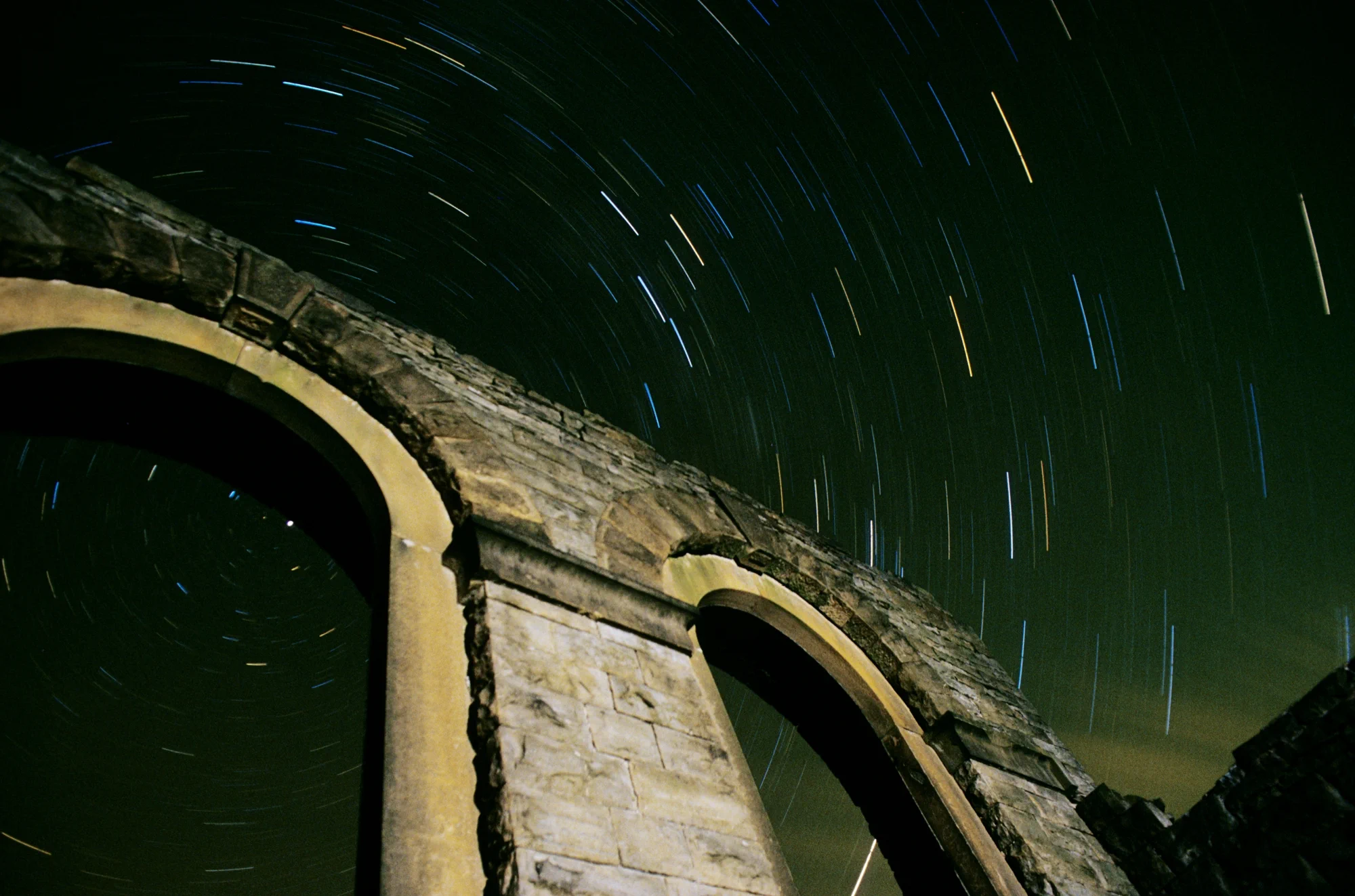
Anyone who read the excellent children’s story The Moon of Gomrath will remember Errwood Hall, in which the evil Morrigan lived. It appeared to be an old ruin most of the time, but when it was night and the light of the old moon fell on it, it was restored to its former complete state, and she could enter or leave it. She had kidnapped one of the children, Colin, while his sister Susan went up to the Hall to find him. The description of Susan’s approach to the Hall along the clough, creeping past the sinister bodachs which guarded it, was something which had made me want to explore the place since childhood, and when I was older I did so. Though there is practically nothing left of the ruin now it’s still a great place to visit, especially when it’s dark.
I’ve been there quite few times at night, but there was one part I never went to. From the ruin a yew-lined track leads back up the valley side, curving round to a point above the house; it is here that the graveyard of the Grimshawe family – the builders of the hall – lies, along with the family vault. Now I can cope with walking through a graveyard at night in a town, but out on the moors, without a soul around, it’s a different matter altogether!
I did however visit a number of times when I went up there with mates (and a spade – I jest!), when it is easier to be bold of heart.
Once three of us were walking from the hall up to the graveyard; we had just started up the track, which was completely covered over by the branches of the yews and therefore almost completely dark, when one of the lads, several metres ahead of us, stepped over a fallen tree which blocked the route. As he did so we saw a dim grey shape rise silently up out of the ground at his feet. He let out a cry and leapt back, while the indistinct shape flitted away up the track. It took only a second to realise it was a sheep, but it wasn’t an experience to be undergone by a decent lad who’d only just changed his underwear.
On another, more restful occasion, the sky started off cloudy, but as the night wore on the cloud cleared to reveal the moon, which lit up the mist-filled valley with a beautiful, diffuse, golden light. It’s impossible to adequately describe the effect – you have to see it. Even a photograph wouldn’t capture it.
However I did try a number of photographs on other occasions, one of which can be seen at the top of the page. The picture was taken using a 20mm lens set at f/4. Having opened the shutter I illuminated the wall with a number of flashes, then left the shutter open for half an hour.
With this length of exposure the star trails are very clear – their apparent movement being the result of the Earth’s rotation. The Pole Star is the most obvious, just under the left arch, but with a bit of work you should be able to find Cassiopeia in the centre, above the middle column.
The greenish colour in the sky is mainly due to reciprocity failure (the original is a slide). The orange parts are light pollution illuminating the underside of a patch of thin cloud at the edge of the picture, probably from the street lights of Buxton.
While it was exposing I wandered round or lay on my back looking at the stars. At one point I was lying in one of the window arches – the floor has been built up with infilled masonry to bring it flush with the sills – looking upwards when a pair of bats flew through just above me. This gave me another challenge, but it wasn’t until a later visit that I eventually managed to get a picture of a bat just as it passed through the window.
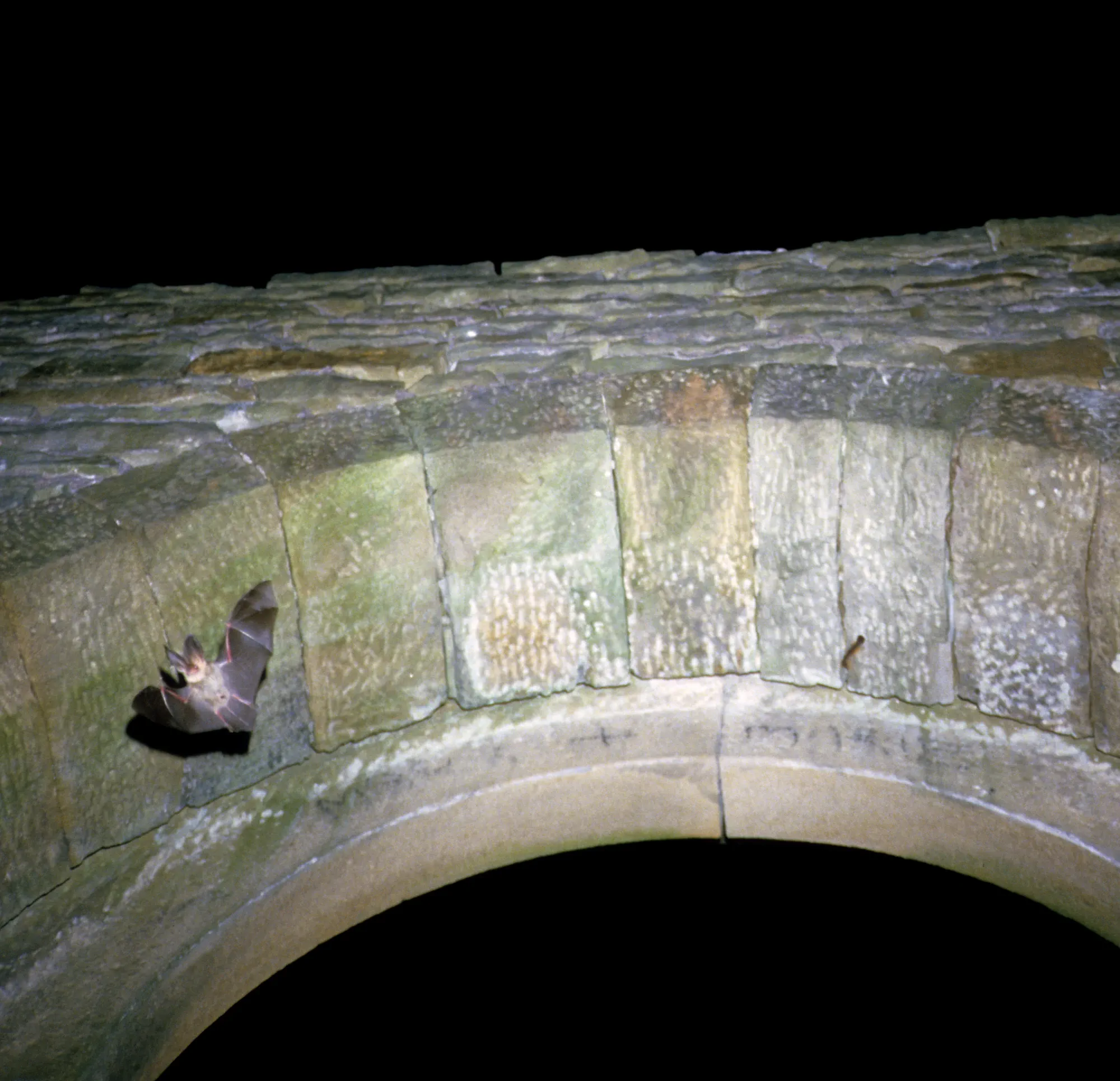 Long-eared bat flying through one of the window arches of Errwood Hall.
Comments
Post a Comment