Do You Use Cash?
A disturbing new form of substance abuse has been emerging at all levels of society in recent years – smoking cash. At first it was confined to a few secretive users at the tip of society – wealthy people who were ashamed to admit their disgusting proclivities to others – but it gradually filtered its way downwards, until teenage muggers were robbing people to get a ‘fix’ in order to fuel their addiction.
Simon, one of the many unfortunates to be in this position agreed to give an interview to our reporter, Tanya (not her real name).
Under the studio lights the two figures show in stark contrast. Simon is slumped in his chair, his clothes dishevelled, twitching nervously, while Tanya is beautifully poised, elegant in her short strapless white dress, her blonde hair tied in a loose ponytail hanging over one shoulder. Tanya gives Simon a wad of banknotes and prompts him to begin.
Simon: Well… I suppose it all started when one of my mates said I should have a go… I thought I could keep it under control. I told myself I’d just take a few sniffs – I wouldn’t inhale – and that I’d be OK.
Tanya: But you were naively and stupidly incorrect, weren’t you, Simon?
Simon (fumbling to roll a five-pound note with trembling hands): Yeah… I guess I was. But everyone was doing it – and all some of them had to do was to crumple a newly minted note under their nose and inhale deeply and they’d get an instant high. Well, it worked at first… but after a bit it wasn’t enough. I needed more. It was then that I first tried… tried… you know… rolling one and lighting up… (Inserting roll-up between lips and patting his pockets desperately.)
Tanya (leaning over and flicking a cigarette lighter): Here, let me…
Simon (inhaling with a grateful sigh, then leaning back in chair with blissfully vacant expression): Ah, that’s better… now, where was I?
Tanya: I’m not sure. Wondering how my dress stays up without any shoulder straps?
Simon: Ah, yes, that was it. No! I mean… At first it wasn’t that bad. But as more and more users started the habit it began to affect the local drug pushers. They’d always been the middlemen, and now their customers were robbing people of cash and smoking it themselves, cutting the dealers out. They thought that if people were going to burn their money it should be done figuratively, not physically. They felt they were facing unfair competition. The local chambers of commerce were unsympathetic however – all trade was being hit; money being burned instead of being spent was going out of circulation. Eventually the government decided to act.
The studio is blue with cash smoke. Simon is more relaxed and coherent now as he pauses to light up a tenner from the remains of his still-smouldering fiver, which he stubs out in an ashtray.
Simon: You remember when the old one pound notes were replaced by one pound coins? Did it ever occur to you to wonder why?
Tanya: Well— the Bank of England said it was because they would last longer than the notes…
Simon: Yes, they did say that, didn’t they? But the real reason was to make it harder for users, and to discourage youngsters from starting the habit. Lighting up a pound note is one thing – a fiver is another. But there was more. They changed the notes. New fivers, tenners, twenties. Make it more difficult for counterfeiters – they said. You want to know the truth?
Tanya (beginning to show signs of edginess): Think of me as being a complete ignoramus, please.
Simon: Right. What was I going to say? Oh, yes. The new currency. Have you ever had the feeling that you don’t have as much money as you thought you should? That you can’t account for where it’s all gone?
Tanya (with a brittle laugh): Of course. All the time.
Simon: Psychotropic drugs in the dye. They affect the short term memory. The idea was to make people forget they were users. Naturally it had to be kept secret. And it worked – for many. Not for the serious users, those who smoked cash in front of people they knew. People like me. But it was ideal for the secret smokers. They would occasionally slip back and have the occasional tenner, but then they’d forget about it before they had time to become seriously addicted. They would never realise they were doing it. Each time would be the first time for them – except it wouldn’t be of course.
Simon breaks off to light up another tenner from the stub of the previous one. Tanya is staring at him, trembling. She begins to shake uncontrollably. She cracks.
Tanya (throwing herself at Simon’s knees and bursting into tears): Oh God! Simon! Give me one! Please! Now! I’ve got to have it!
Simon (his voice tinged with compassion): Here you go. (He slips his joint between her perfect lips.) You can suck on mine.
Tanya drags on the tenner, gradually recovering her composure. Her trembling eases. She looks around, faintly puzzled, then returns to her seat. She fishes around in her bag for a moment then produces a cigarette holder, into which she inserts the tenner.
Tanya: Er… where were we?
Anyone who has experienced the feeling they should have more money than they do, or that they cannot account for where all their money has gone should consider the possibility that they are unknowing victims of this addiction. Seek help now – before it’s too late.
NOTES
Astonishing though it may seem, there is a reason why I created this satirical piece, and why it features a beautiful young woman smoking a rolled-up banknote. There is even a reason for the seemingly pointless way Tanya asks me – Simon, I mean – if he was wondering how her dress stayed up without any shoulder straps. There is a reason for everything, even Boris Johnson.
It goes back to 1983. My younger sister, Jane, had started at Newcastle University, where she was to take her doctorate in chemistry. Yes, my brother Nick has a BSc in Mathematics and my sister Jane has a PhD in Chemistry; I am the dull-witted one of the family. I realise that may seem hard to believe, but you should remember the example of Sherlock Holmes and his brother Mycroft. Anyway, Jane was evidently feeling somewhat homesick, for I sent her a letter with a set of pencil drawings – a four-panel cartoon, essentially. The one on the upper left is reproduced below, by kind permission of the artist – in fact, in a spirit of generosity, he has included the one on the top right, at no additional charge, as it fills the screen better when viewed in a desktop browser. It has become rather smudged, but you should be able to see Tanya, smoking a rolled-up banknote held in a cigarette holder, and, at the foot of the picture, the words ‘It’s supported by Art’ – in reference, of course, to her strapless dress. Or possibly to the table. Or the seat? That, sadly, will remain one of those great mysteries of life.
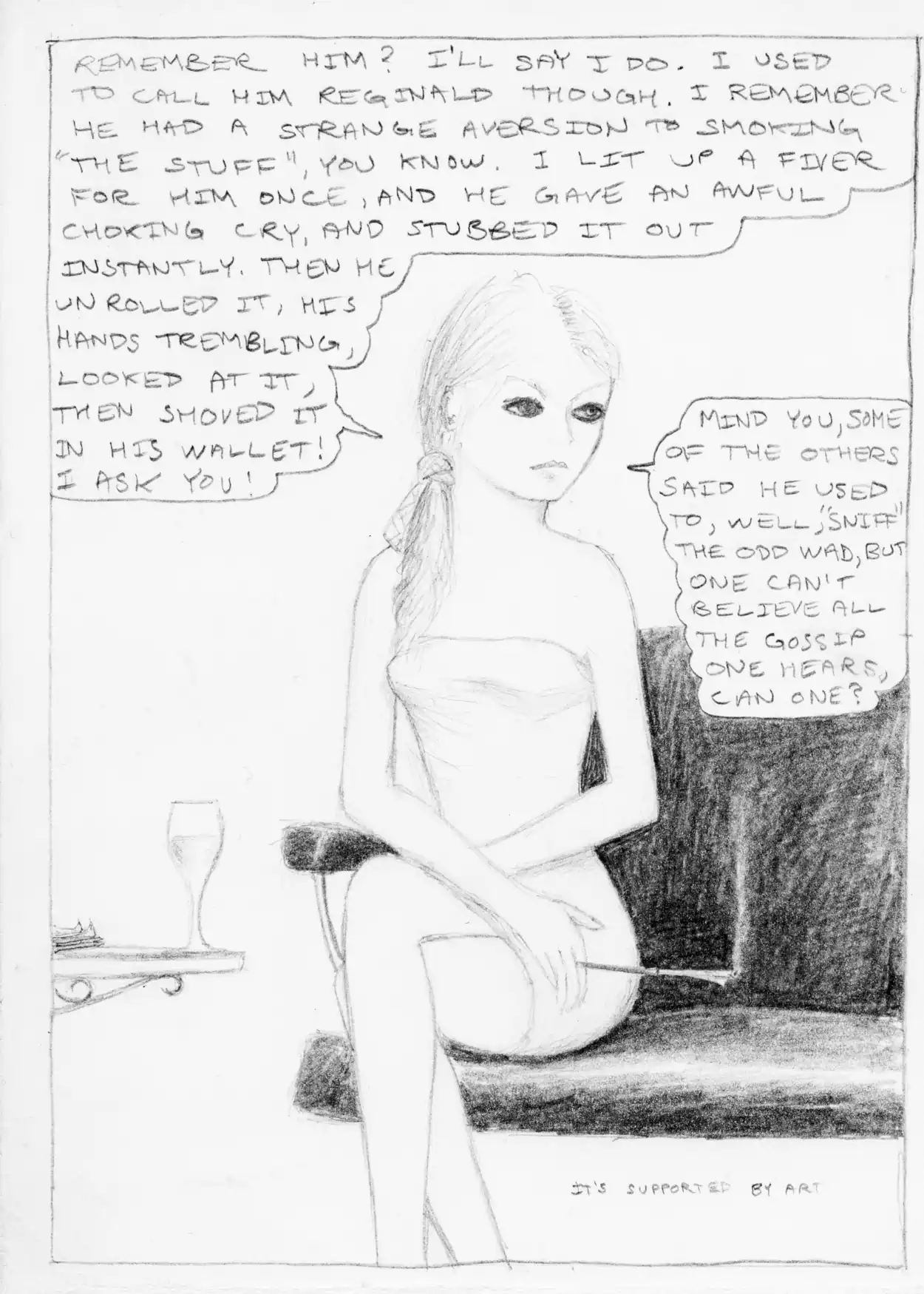
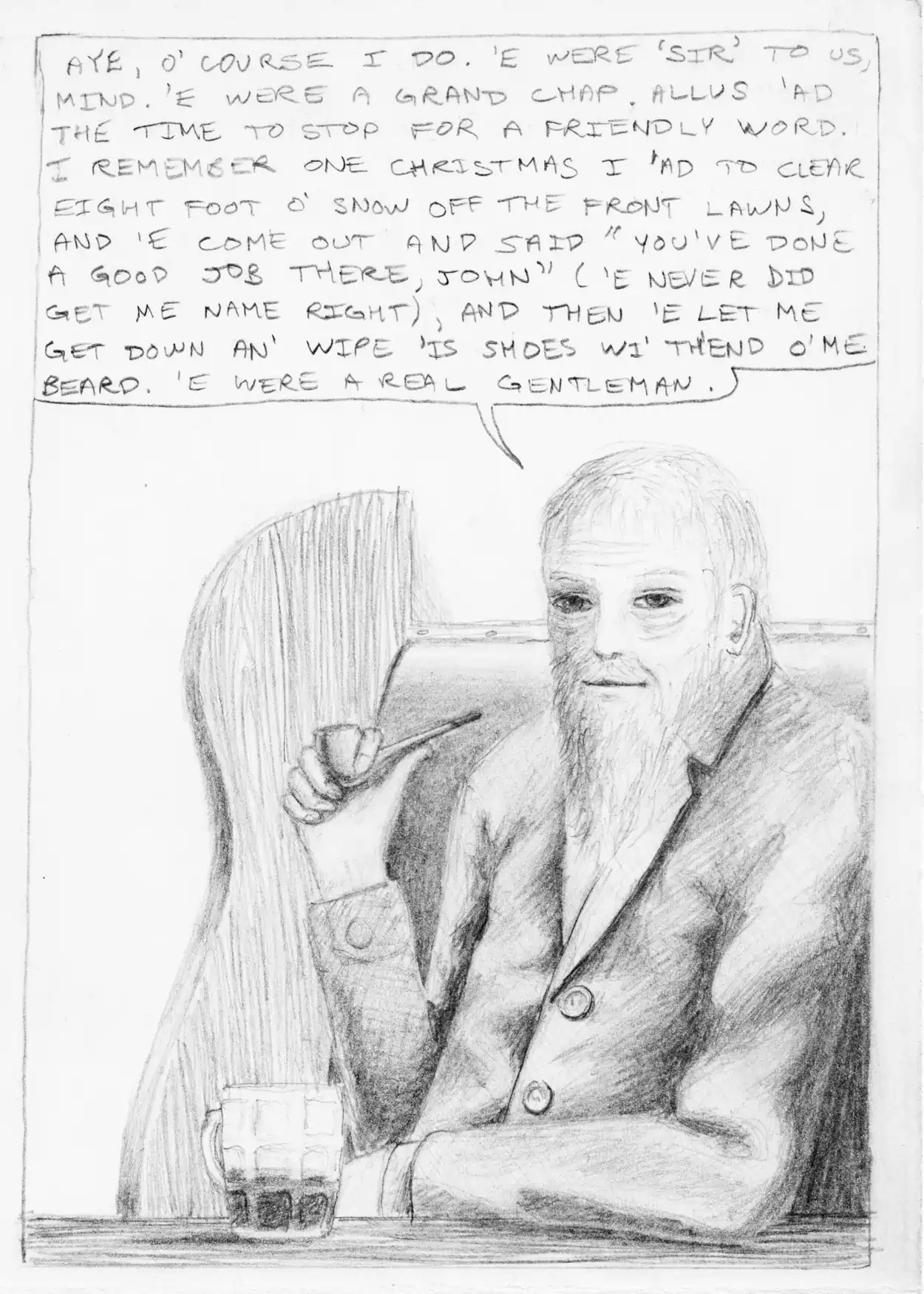
But all that matters to you, dear reader, is that it was the inspiration of this piece about one of the lesser-known evils in our society, and one that was finally resolved by the Bank of England’s decision to make banknotes out of biaxially oriented polypropylene. They said it was so they would last longer, but I think anyone who has read the above will know the truth.
I should also add that at the time I drew the cartoon I was somewhat ironically in the initial stages of becoming addicted to the diazepam that had been prescribed to me for my social phobia, though I did not yet realise it.
Comments
Post a Comment